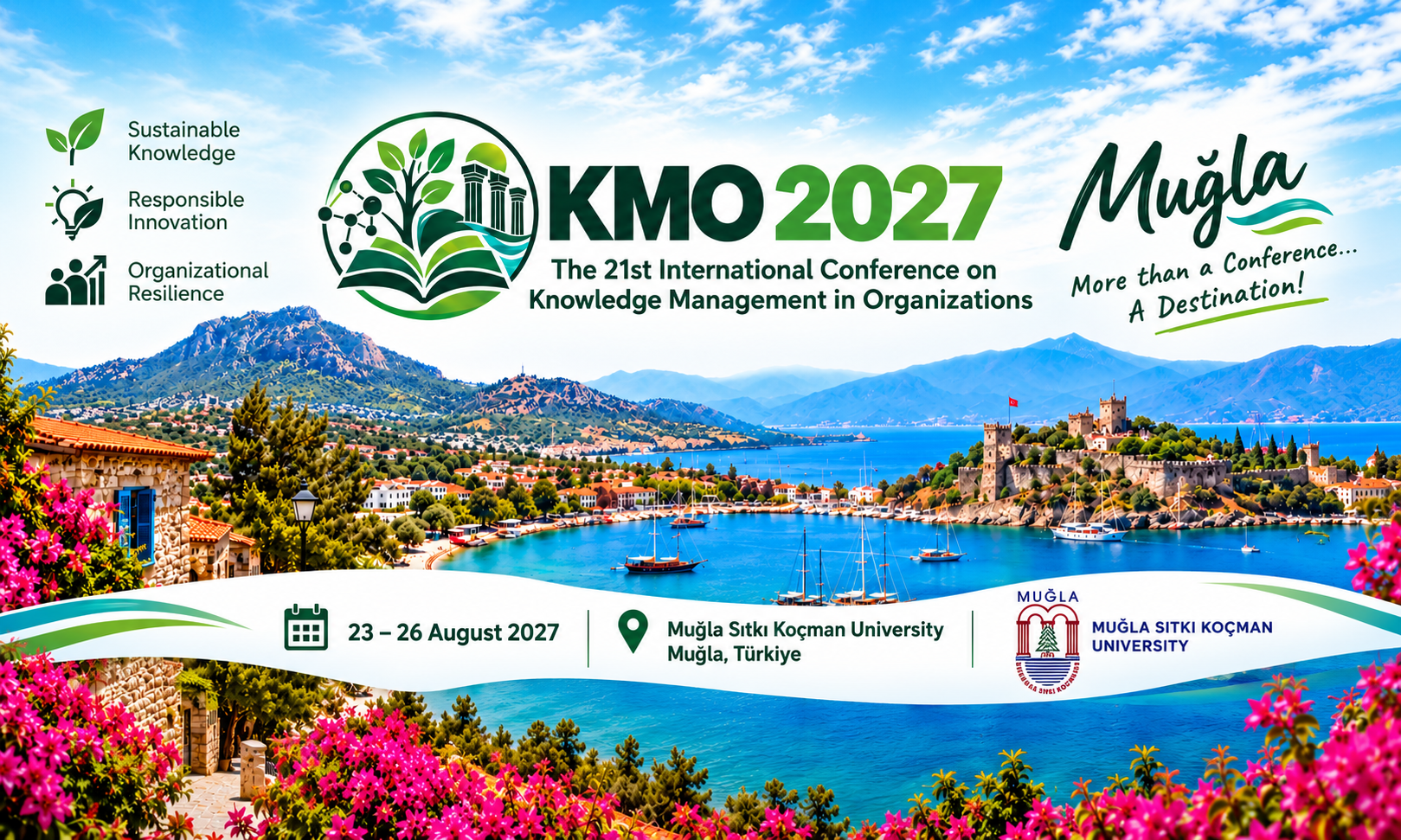
KMO 2027 Call for Papers
From Generative AI to Augmented Knowledge Organizations: Human–AI Collaboration, Agentic Systems, Wisdom and Sustainable Futures
21st International Conference on Knowledge Management in Organizations — KMO 2027
Dates: 23–26 August 2027 (optional tour on 27 August 2027)
Venue: Muğla Sıtkı Koçman University, Faculty of Education, Instructional Technologies, 48000 Muğla, Türkiye
Conference Theme
Knowledge Management (KM) is entering a new phase. The rapid development of generative artificial intelligence has already transformed how organisations search for, create, codify, synthesise and communicate knowledge. The next challenge, however, extends beyond the use of Generative AI as a knowledge-support tool. Increasingly autonomous and agentic AI systems can plan, reason, coordinate tasks and participate in organisational decision-making with decreasing levels of direct human intervention. Emerging research consequently points toward AI-orchestrated organisations in which AI may become part of the organisational infrastructure through which knowledge, decisions and work are coordinated.
These developments raise fundamental questions for Knowledge Management. What constitutes organisational knowledge when knowledge is created jointly by humans and intelligent machines? Who owns, validates and takes responsibility for machine-generated organisational knowledge? How should tacit human knowledge interact with explicit, computational and machine-generated knowledge? How can organisations obtain the benefits of increasingly autonomous AI without weakening human expertise, critical judgement, creativity, agency and organisational memory?
Recent research suggests that GenAI may require reconsideration of established KM models, including the SECI model, because organisational knowledge creation is increasingly becoming machine-augmented rather than exclusively human-centred. At the same time, evidence suggests that automation and augmentation have different consequences depending on whether knowledge is tacit or explicit: AI may improve scalability and knowledge access while simultaneously introducing risks involving opacity, bias, deskilling, loss of context, reduced critical thinking and weakened trust.
KMO 2027 therefore asks a broader question:
How can organisations create human–AI knowledge ecosystems that are intelligent, trustworthy, participatory, resilient, sustainable and wise?
The conference particularly welcomes work that moves beyond technological capability to investigate the human, epistemic, organisational, ethical and societal consequences of AI-mediated knowledge. KMO 2027 invites scholars, practitioners, doctoral researchers and interdisciplinary research communities to examine these questions critically.
Key Themes and Research Directions
Papers are invited that address, but are not limited to, the following areas:
- Rethinking Knowledge Management Theory in the AI Era
- Agentic AI and Autonomous Knowledge Systems
- Human–AI Knowledge Collaboration and Augmented Intelligence
- Knowledge Quality, Truth, Trust and Epistemic Governance
- Wisdom-Based Knowledge Management
- Generative AI, RAG and Enterprise Knowledge Systems
- Organisational Learning in Human–AI Ecosystems
- Knowledge Workers, Skills and the Future of Work
- Knowledge Democratisation versus Cognitive Homogenisation
- AI Governance, Ethics and Responsible Knowledge Management
- Knowledge Management, Sustainability and Organisational Resilience
- Innovation, Entrepreneurship and Knowledge Ecosystems
- Knowledge Management in Application Domains
- Emerging Knowledge Technologies
- New Research Methodologies for Knowledge Management
For the full list of themes and research directions, please see the Themes and Research Directions page.
Research Questions of Particular Interest
The conference particularly encourages papers addressing questions such as:
- Can an AI system genuinely “know,” or does knowledge remain fundamentally human and social?
- Does the SECI model remain adequate when machines participate directly in knowledge creation?
- How does tacit knowledge change when AI increasingly mediates organisational interaction?
- When should organisations automate knowledge work, and when should they augment human expertise?
- Can autonomous AI agents become legitimate organisational knowledge actors?
- Who is accountable when organisational knowledge is generated or acted upon autonomously by AI agents?
- How can organisations prevent AI-supported KM from producing deskilling, cognitive dependency or knowledge homogenisation?
- How should AI-generated organisational knowledge be verified, governed and preserved?
- What constitutes organisational wisdom in human–AI systems?
- How can KM contribute to human flourishing, sustainability and the common good rather than merely efficiency?
Types of Contributions
KMO 2027 welcomes:
- theoretical and conceptual papers;
- empirical quantitative and qualitative studies;
- systematic and critical literature reviews;
- design science and action research;
- organisational case studies;
- technical KM system research;
- human–AI interaction studies;
- policy and governance research;
- interdisciplinary research;
- doctoral and emerging research;
- industry and practitioner studies.
Tutorials
The conference is preceded by one day of free tutorials for participants who wish to learn the state of the art of research relating to the topics of KMO and LTEC. The tutorials will be held on 23rd August 2027. The conference itself commences on 24th August 2027 and runs until 26th August 2027, followed by an optional tour on 27th August 2027.
For the invitation to submit a tutorial proposal, please see the Tutorial Proposals page.
Deadline for tutorial submission: 12th February 2027
Instructions for Authors
Papers reporting original and unpublished research results pertaining to the above topics are solicited. The deadline for full paper and all other submissions is 12th February 2027. These papers will undergo an academic review process. Full paper manuscripts must be in English with a maximum length of 12 pages (using the Springer template). All papers are blind reviewed.
IMPORTANT: Please do not include the author(s) information in the FIRST submission of the paper, for double-blind review to be carried out.
For more information, please see the Instructions for Authors page and the Springer series Communications in Computer and Information Science (CCIS).
Review Process
KMO 2027 welcomes the submission of papers with reference to the topics listed in the call for papers. All submitted papers will undergo a double-blind peer review by at least three experts in the field, based on relevance, originality, significance, quality and clarity.
Submitting Papers
All papers must be formatted according to the Springer template, with a maximum length of 12 pages, including figures and references. All proposed papers must be submitted in electronic form (WORD format) using the Paper Submission Page:
https://easychair.org/conferences/?conf=kmo2027
Publication
Accepted papers will be included in the KMO 2027 Proceedings. At least one of the authors will be required to register and attend the conference to present the paper in order to include the paper in the conference proceedings.
Important Deadlines
- Submission of tutorial: February 12th, 2027
- Deadline for paper submission: February 12th, 2027
- Author notification: March 15th, 2027
- Deadline for camera-ready paper: April 2nd, 2027
- Conference dates: August 23rd–26th, 2027
- Optional tour: August 27th, 2027
- Early bird registration: Before June 1, 2027
- Last day of registration: July 15th, 2027